

Conference Report: Diagnostics for Low and Middle-Income Countries 2025
Dr Philip Fowler reports on our most successful Dx4LMICs to date
Reuben College hosted its third Diagnostics for Low and Middle-Income Countries (Dx4LMICs) Conference at the very start of July. Professor Lord Tarassenko welcomed around 135 attendees, making this our largest conference yet, and then got the conference underway in our hall. The conference attracts students and researchers from a wide range of disciplines, and it was great to see so many PhD students asking questions and talking to the speakers at the coffee breaks and at lunch.
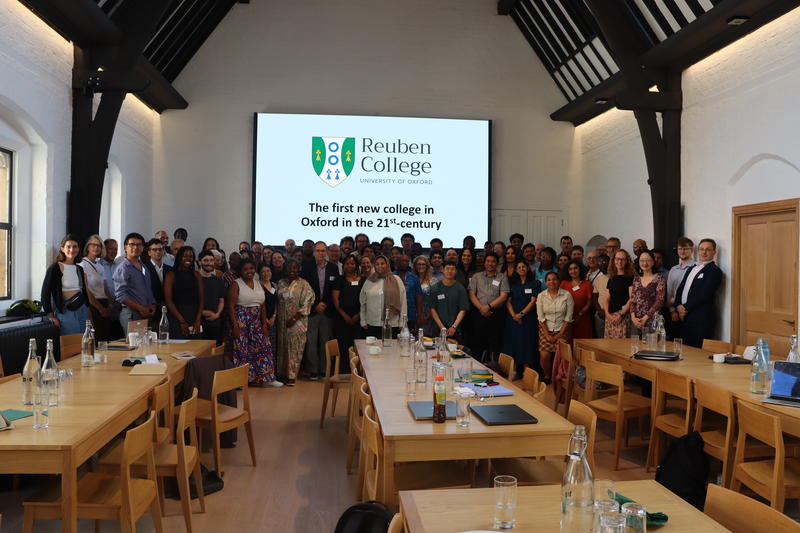
Our conference photo, taken with organisers, speakers and attendees at the end of Day Two
Day One
On the first day, we heard from several AfOx Fellows, including a project focused on improving the uptake of HIV self-testing in Uganda. We also explored important potential technological advancements, such as how nano diamonds could enable much more sensitive lateral flow tests (LFTs). Another showed how machine learning models, trained on individual patient pulse oximeter data in Vietnam, can detect spot if a patient starts to deteriorate. We additionally enjoyed keynote talks from Professor Arjune Sen, Director of the Centre for Global Epilepsy, and Sonny Michael Assennato from Diagnostics for the Real World (DRW) Ltd.
A few hours after the day session closed, we reconvened for pre-dinner drinks (generously sponsored by ProtonDx) and enjoyed a thoughtful after dinner speech by Dr Vivian Lee from Harvard.
Day Two
The morning of the second day dug into the topic of Infectious Diseases, including talks on wastewater surveillance and lessons learned from the rollout of malaria LFTs. This thought-provoking session was closed by a keynote from Professor Dame Molly Stevens, the current John Black Professor of Bionanoscience at Oxford's Institute of Biomedical Engineering.
After lunch, we switched our focus to Artificial Intelligence & Machine Learning and explored its applications in electrocardiogram analysis, cardiac diagnostics and supporting maternal health in India. To close this session and the conference, we were delighted to have Professor Alan Bernstein (Director of Oxford Global Health & Visiting Professor of Global Health) present on the current challenges and opportunities for Oxford Global Health.

Professor Lord Tarassenko with our two poster competition winners
Reflections
We tried to do a few things differently this year. The day before the conference, Dylan Adlard led a very successful online data science workshop (in collaboration with PhysioNet Challenges) looking at the challenges of using real clinical data to build machine learning models to diagnose Chagas disease. We’d like to explore these type of interactive sessions more in future.
More conventionally, we ran a poster competition where the entire conference could vote for their favourite poster. We’ve already had some ideas about what would like to do next year, so watch this space!
More from the conference
Head to the Diagnostics for LMICs page to see our conference gallery, select slides, and links to recordings

